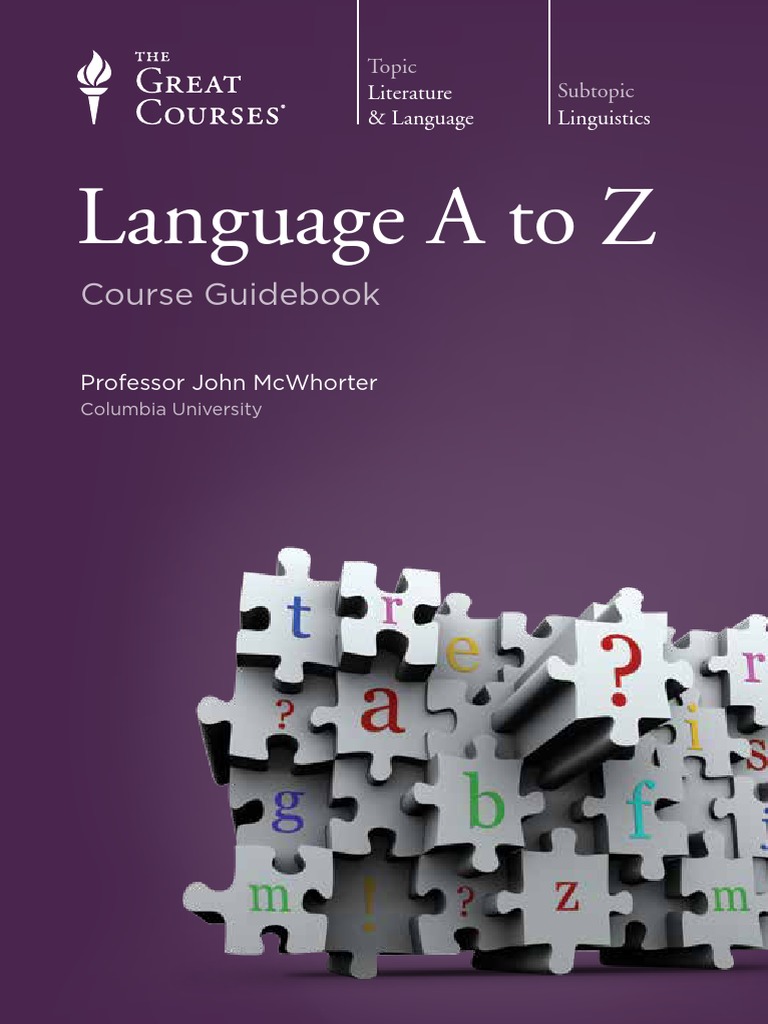
I’m something of a language nerd, and I often wish I could go back to college to study linguistics. (In reality, I double majored in English and Communication, so not entirely far off.) Thankfully I’ve found an incredible alternative: The Great Courses’ audiobooks on Linguistics. I just listened to Language A to Z by John McWhorter, and though short, it packs in a breadth of information in a rapid and entertaining way. What a fun crash course in linguistics!
| Language A to Z by John McWhorter | |
|---|---|
| Audience | Adult |
| Genre | Nonfiction: Linguistics |
| Length of Audiobook | 6 hours, 13 minutes |
| Format I Read | Audiobook |
| Original Publication Date | November 12, 2013 |
Official Summary
Linguistics, the study of language, has a reputation for being complex and inaccessible. But here’s a secret: There’s a lot that’s quirky and intriguing about how human language works-and much of it is downright fun to learn about. But with so many potential avenues of exploration, it can often seem daunting to try to understand it. Where does one even start?
In these twenty-four 15-minute lectures by one of the best-known popularizes of language, you’ll discover a delightful way to get accessible, bite-sized introductions to language. Using the English alphabet as a unique, offbeat way to approach the subject, Professor McWhorter has crafted a hopscotch tour of some of the field’s major topics, hot-button issues, and more.
You’ll learn why it can actually be OK to use slang like “LOL.” Why English speakers don’t use words like “thou” and “thee” anymore. What makes “mama” and “papa” a child’s first words-in many languages. How popular rhymes like “Eeny, meeny, miney, moe”) actually derive from the words for numbers in an early relative of Welsh. Why “like” is here to stay in common American speech. And much more.
These and other fascinating topics are all delivered in Professor McWhorter’s light-hearted yet informative teaching style, which makes this series essential for anyone looking for a welcoming window into the quirks, curiosities, and intricacies of how language works. Filled with humor, whimsy, and no shortage of insights, it’s a fast-paced tour of the same territory linguists tread each and every day.
Review
Language A to Z covers all 26 letters of the alphabet, offering a brief, 15-minute course on each subject. (However, note that there are only 24 chapters because four of the letters doubled up.) Some letters come with a particular language (like Aramaic or Ket), a form of usage (like compounds or plurals), or something related to popular culture (like Hobbits or how Bugs Bunny is known for saying “What’s up, Doc?”). I appreciated the variance in topics, which kept this book a bit unpredictable and surprising.
John McWhorter is an amazing lecturer. His delivery is energetic, humorous, and entertaining. He’s the kind of teacher who could make any subject fun, and he certainly showed Linguistics in the most diverting light I can imagine. It’s clear that he’s both passionate and extremely knowledgeable about the subject!
A lot of this book gives historical context for how language—or even a certain aspect or specific phrase in a language—evolved into what it is today. I loved seeing why we communicate as we do and that language is always changing.
Because the chapters are so short, none of them are by an means exhaustive on their particular subject. Rather, they feel like an intriguing teaser to inspire further discovery if you choose to learn more. These are introductions into the many facets of linguistics, and it left me wanting to pursue more courses like this one.
Below is a list of each letter and what it stands for in Language A to Z. The letters P and Q are joined for chapter 16; X and Y are joined for chapter 23.
- A for Aramaic
- B for Baby Mama
- C for Compounds
- D for Double Negatives
- E for Etymology
- F for First Words
- G for Greek Alphabet
- H for Hobbits
- I for Island
- J for Jamaican
- K for Ket
- L for “Like”
- M for Maltese
- N for Native American English
- O for Oldsters in Cartoons
- P for Plurals
- Q for Quiz
- R for R-Lessness
- S for She
- T for Tone
- U for Understood
- V for Vocabulary
- W for “What’s Up, Doc?”
- X for !Xóõ
- Y for Yiddish
- Z for Zed
Final Thoughts
I really loved Language A to Z and flew through it! I didn’t want it to end, and I would love to go through all of John McWhorter’s Linguistics courses from the The Great Courses. The one was freeform and fun, while the others look perhaps more focused. Regardless, this was a ton of fun and a great introduction to linguistics and how language has evolved over time.
About the Author

John McWhorter teaches linguistics, philosophy, and music history at Columbia University, and writes for various publications on language issues and race issues such as Time, the Wall Street Journal, the Daily Beast, CNN, and the Atlantic. he told his mother he wanted to be a “book writer” when he was five, and is happy that it worked out.
More Books Like This
The History of Spain: Land on a Crossroad
Last summer, I decided to listen to my first audiobook. Something about listening to fiction seems weird to me, so I decided to start with…
So You Want to Talk About Race
In light of the recent upsurge in support for Black Lives Matter and calls for racial justice, I’ve spent the past couple of months working…
Finding Latinx: In Search of the Voices Redefining Latino Identity
In the past couple of years, I’ve had a growing interest in reading more nonfiction about identity, especially related to racial diversity and immigration. This…
Discover more from Amanda's Book Corner
Subscribe to get the latest posts sent to your email.


 Amanda's Book Corner
Footnotes