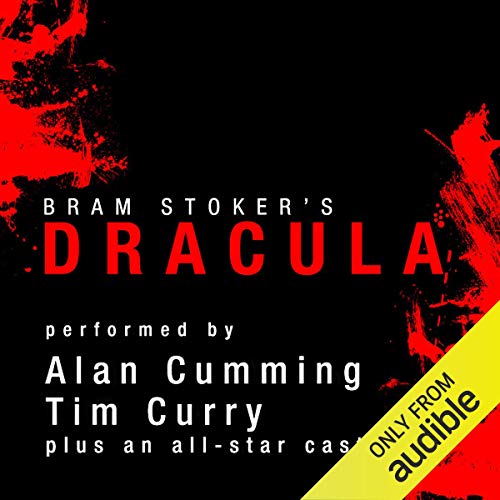
Lately, I’ve been wanting to read more classics. Despite having a bachelor’s degree in English, there are still so many well-known novels that I haven’t read (and so many I’d like to reread)! I decided to get a head start on Spooky SeasonTM by diving into one of the horror classics, Dracula by Bram Stoker. I was familiar with the general gist of it, of course, and have seen the 1922 silent film adaptation, Nosferatu, different as it is from its source material. But I didn’t know the original book. For my first foray into this classic, I opted for a full-cast audiobook, and it really brought the whole story to life.
Review
Like most, I grew up with a general idea of who Count Dracula is thanks to his ubiquity in popular culture. When you think of vampires, he’s the first to come to mind, right? But I had never read Bram Stoker’s 1897 book introducing this character. Now that I’m getting into the classics, and with Spooky SeasonTM fast approaching, now felt like a great time to finally get to know this piece of classic horror.
The first part of Dracula is my favorite. It’s told from Jonathan Harker’s perspective while he stays in Count Dracula’s castle in Transylvania. What’s meant to be a short visit, as Dracula’s new solicitor, turns into many weeks of entrapment and increasing worry over his life. Through Harker’s journal entries, the sense of fear and turmoil build up wonderfully, and Dracula himself becomes increasingly unsettling. From the strange emptiness of the castle to the feverish dreams that haunt Harker, the dread and storytelling here are superb.
However, when the novel switched over to the numerous other characters living in England, I found my interest wavering. Indeed, the bulk of the novel actually focuses on these characters, from Lucy Westenra and Mina Murray (Jonathan Harker’s fiancée) to Dr. John Steward and Professor Abraham Van Helsing. Between their different letters, journal entries, and so on, the story now follows Lucy’s strange illness and the doctor and professor’s attempts to save her. In time, it becomes clear that Dracula is a vampire infecting his victims. The full cast of characters then work together to defeat Dracula before another life is lost.
At times, I greatly enjoyed this latter (and much longer) portion of Dracula. I loved the folklore surrounding vampires and seeing how the characters puzzled out the ways to track down the vampire and destroy him. But at other times, I found the story less engaging or focused; it felt like much of it could have been edited out and it would have been stronger for it.
Further, I had hoped Dracula would be a bit scarier. It has good suspense and some great points of terror, but it never went far enough to make me feel scared. That may just be me, though: I’ve watched countless horror films and may just be too desensitized by this point!
Audiobook
The audiobook version I listened to, narrated by a full cast, greatly added to my enjoyment of Dracula. The many narrators brought each character to life, making each more vivid and distinct. It made for a much more immersive experience and generally kept me engaged (lagging portions notwithstanding).
Final Thoughts
Overall, I enjoyed a lot about Dracula, even if the pacing was sometimes uneven and it wasn’t as scary as I’d anticipated. It’s written in an epistolary narrative style, fully told by characters’ first-hand accounts via journal entries, letters, and more, which makes it stand out compared to other 19th century novels. I’m glad to have finally read this classic piece of horror and I would love to read more of Bram Stoker’s many novels.
This reading of Dracula will kick-start my upcoming vampire books readathon in October. I have several vampirish novels picked out, some directly inspired by Dracula, and others including vampires in a more casual (or even cute) capacity.
Get the Book
You can buy this Audible production of Dracula here. However, other audiobook, paperback, hardcover, and ebook editions of Dracula are also widely available.
| Dracula by Bram Stoker | |
|---|---|
| Audiobook Narrator | Full Cast |
| Audience | Adult |
| Genre | Horror; Gothic; Classics |
| Setting | Romania; England |
| Audio Time | 15.5 hours |
| Format I Read | Audiobook |
| Original Publication Date | 1897; audio 2013 |
Official Summary
Because of the widespread awareness of the story of the evil Transylvanian count and the success of numerous film adaptations that have been created over the years, the modern audience hasn’t had a chance to truly appreciate the unknowing dread that readers would have felt when reading Bram Stoker’s original 1897 manuscript. Most modern productions employ campiness or sound effects to try to bring back that gothic tension, but we’ve tried something different. By returning to Stoker’s original storytelling structure – a series of letters and journal entries voiced by Jonathan Harker, Dr. Van Helsing, and other characters – with an all-star cast of narrators, we’ve sought to recapture its originally intended horror and power.
This production of Dracula is presented by what is possibly the best assemblage of narrating talent ever for one audiobook: Emmy Award nominees Alan Cumming and Tim Curry plus an all-star cast of Audie award-winners Simon Vance (The Millenium Trilogy), Katherine Kellgren (Pride and Prejudice and Zombies), Susan Duerden (The Tiger’s Wife), John Lee (Supergods) and customer favorites Graeme Malcolm (Skippy Dies), Steven Crossley (The Oxford Time Travel series), Simon Prebble (The Baroque Cycle), James Adams (Letters to a Young Contrarian), Nicola Barber (The Rose Garden), Victor Villar-Hauser (Fun Inc.), and Marc Vietor (1Q84). These stellar narrators have been cast as follows:
Alan Cumming as Dr. Seward
Simon Vance as Jonathan Harker
Katy Kellgren as Mina Murray/Harker
Susan Duerden as Lucy Westenra
Tim Curry as Van Helsing
Graeme Malcolm as Dailygraph correspondent
Steven Crossley as Zookeeper’s account and reporter
Simon Prebble as Varna
James Adams as Patrick Hennessey
Nicola Barber as Sister Agatha
Victor Villar-Hauser as Arthur Holmwood
Marc Vietor as Quincey Morris
John Lee as Introductory paragraph, various letters
About the Author

Abraham (Bram) Stoker was an Irish writer, best known for his Gothic classic Dracula, which continues to influence horror writers and fans more than 100 years after it was first published. Educated at Trinity College, Dublin, in science, mathematics, oratory, history, and composition, Stoker’ s writing was greatly influenced by his father’ s interest in theatre and his mother’ s gruesome stories about her childhood during the cholera epidemic in 1832. Although a published author of the novels Dracula, The Lady of the Shroud, and The Lair of the White Worm, and his work as part of the literary staff of The London Daily Telegraph, Stoker made his living as the personal assistant of actor Henry Irving and the business manager of the Lyceum Theatre in London. Stoker died in 1912, leaving behind one of the most memorable horror characters ever created.
More Books Like This
Jane Eyre
The first classic novel I profoundly connected with when I was young was Jane Eyre by Charlotte Brontë. I was a high school junior then,…
Unnatural Creatures: A Novel of the Frankenstein Women
I’ve had a book by Kris Waldherr on my shelf for a couple of years, and though I haven’t read that, I was excited when…
What Moves the Dead
T. Kingfisher is an author I’ve been meaning to get into. Her 2020 novel The Hollow Places is on my bookshelf, eyeing me impatiently, and…
Discover more from Amanda's Book Corner
Subscribe to get the latest posts sent to your email.


 Amanda's Book Corner
Footnotes